

Teaching looks straightforward from the outside. Most people picture the classroom and stop there. What they miss is everything around it, the grading, the lesson plans, the parent emails, and the staff meetings that fill up the hours before and after the bell rings.
This teaching career guide is for anyone seriously weighing that reality. At On The Culture, we’ve worked with educators at every stage of the profession, and one thing comes up consistently.
The teachers who thrive are not always the most confident ones walking in. More often, they are the ones who took the time to ask the right questions before they started. That is what this guide is here for. We will walk you through the core teacher skills, the daily realities, and the honest expectations that come with the job.
By the end, you’ll know for sure whether this path is genuinely the right one for you.
What Does a Teaching Career Actually Look Like?
Most people picture teaching as standing in front of a classroom. What they miss is everything around it, like grading, lesson plans, parent emails, and back-to-back meetings. These are the hidden responsibilities teachers manage daily, and most outsiders never fully account for them.
Picture a regular Tuesday morning: you arrive early, find a parent email waiting before first period, then teach several classes with barely a break. And frankly, that inbox full of messages before the bell even rings is something nobody really prepares you for.
As the Bureau of Labor Statistics confirms, teachers carry a surprisingly wide range of duties outside direct instruction. That is part of what makes the teaching profession so demanding, and for most, so worth it.
Teacher Skills You’ll Want to Build Early On

Most essential teacher skills can be learned and strengthened over time, which is genuinely good news if you are still figuring out where you stand.
From what we’ve seen, the teachers who hit a wall in year one weren’t struggling because they didn’t know their subject. They just weren’t ready for how demanding the day-to-day would actually be. These three skills tend to separate the teachers who find their footing quickly from the ones who don’t.
Organization and Time Management
Strong organizational skills help teachers stay on top of lesson plans, student progress, and deadlines without constantly feeling behind. That disorganization does not stay contained to the teacher’s desk either. It bleeds into the classroom, and students pick up on it faster than most new teachers expect.
Patience With Students Who Struggle
Some students need the same concept explained several different ways before it clicks, and that is completely normal. What catches many new teachers off guard is just how often that happens, because in year one, it feels like it is happening every single day.
Staying Flexible When Plans Fall Apart
Even carefully prepared lesson plans can unravel quickly. And real students in an actual classroom have a way of taking things in a direction you did not plan for. Here, learning to read the room and adjusting on the fly is something that comes with time, and honestly, it is one of those things you only truly get by doing it.
Now, let’s look at how communication fits into all of this, because it is more specific than most people assume.
Communication Skills That Make or Break Your Classroom
Ever watched a teacher lose a classroom in under five minutes? Poor communication is almost always the reason. And it is not just about how clearly you explain a lesson. It covers everything from how you write emails to how well you listen when a student is struggling.
Here are the three communication areas worth paying attention to:
- Verbal Communication Skills: Clear instructions help students know exactly what is expected. When a teacher over-explains or uses inconsistent language, students check out before you even finish the sentence (twenty minutes on a two-minute task, and students never forget it).
- Written Communication Skills: Keeping parents and school administrators informed builds trust on both sides. And working effectively with parents and families shapes how your classroom is perceived all year long.
- Practice Active Listening: Students give you signals constantly. Picking up on confusion or distress early keeps the learning environment healthier for everyone.
Ultimately, good communication builds the kind of classroom where students feel valued and ready to engage.
Classroom Management: Can You Handle 30 Kids at Once?

Classroom management is one of the hardest challenges new teachers face, and it rarely comes naturally at first. You can read about it, take courses on it, and still feel underprepared when thirty students walk through your door on day one.
To put it plainly, here is what that difference looks like side by side.
| Factor | Strong Management | Weak Management |
| Learning time | Maximized through clear structure | Lost to constant disruptions |
| Student behavior | Predictable and calm | Inconsistent and reactive |
| Teacher energy | Focused on actual teaching | Drained by behavioral issues |
| Classroom trust | Built steadily over time | Difficult to establish |
Honestly, walk into a classroom where the teacher never nailed down a routine and you can feel it within two minutes. Students are off-task, the teacher is reacting instead of teaching, and everyone in that room knows something is off.
Two methods tend to work in this situation:
- Setting Clear Routines: Rules and expectations set in the first week do a lot of the heavy lifting for the rest of the year. A classroom where students know the drill from day one runs more smoothly, and that structure creates a positive learning environment where actual teaching can happen.
- Consistency Builds Trust: New teachers are often surprised by how closely students watch them. Enforcing expectations the same way every single time, even when it is inconvenient, is what gradually builds a positive classroom environment that students respect.
Once that is established, the conversation shifts to something teachers do not always expect to need: real leadership.
Why Leadership Skills and Critical Thinking Matter
Most people do not picture a teacher when they think of a leader. But walk into any classroom, and that assumption falls apart pretty quickly. You are guiding a room full of people, reading the energy, and making calls about the lesson in real time. That is leadership, whether the job title says so or not.
What’s more, these leadership skills do much more than just keep order. Take a math teacher mid-lesson who suddenly realizes half the class looks lost. Do you slow down, switch examples, or push through? That split-second read is something teachers navigate constantly (and when that judgment slips, students notice before you do).
Critical thinking also plays into every one of those moments. According to recent data on how teachers actually spend their time, a significant portion of a teacher’s day happens outside direct instruction.
So, adjusting your teaching methods on the fly and keeping student learning moving forward is something you rely on every single day, not just when things go sideways.
Now that we have covered leadership, it is worth talking about what happens when things get tense (and they will).
Conflict Resolution Skills Every Teacher Needs
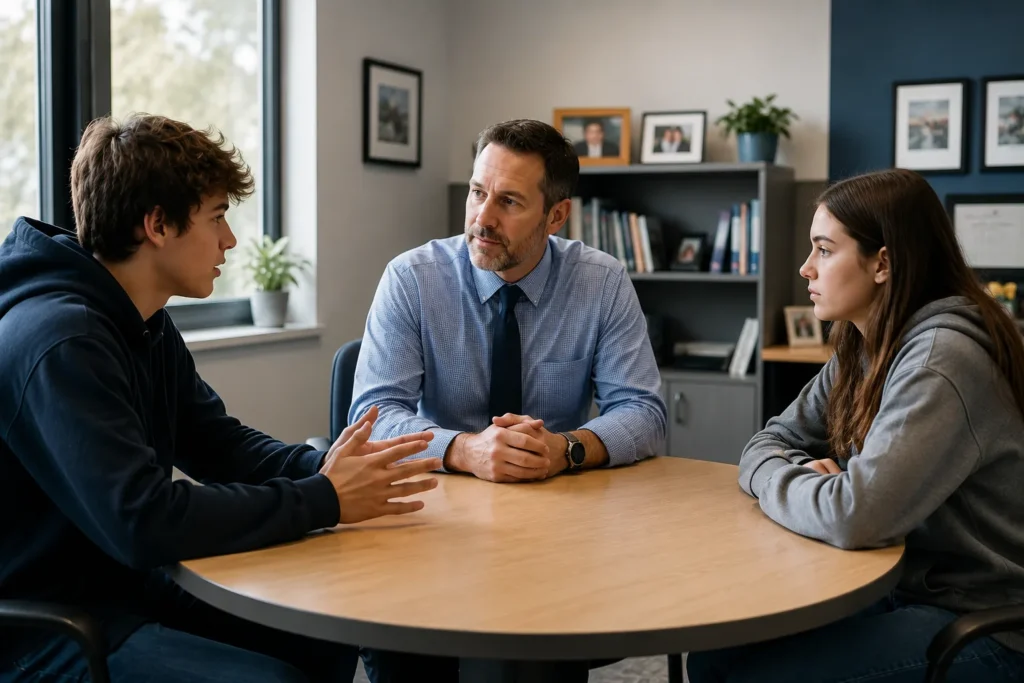
The good news is that conflict resolution skills are something you can build deliberately, long before you actually need them.
Here is where conflict tends to show up most.
- Student Disagreements: Mediating calmly without taking sides is what keeps the classroom setting stable. When a teacher steps in the wrong way, students stop seeing them as a neutral presence, and that loss of trust makes every future disagreement harder to manage.
- Parent-teacher Conflict: At some point, you will sit across from a parent who is absolutely convinced their child can do no wrong. There is no way around this, and the teachers who handle it best are the ones who keep their tone even and steer the conversation back to student progress rather than personalities.
- Unresolved Tension: When conflict gets ignored, the whole class feels it. Engagement drops, focus shifts, and before long, the learning environment starts working against you (ignore it once, and students will test that boundary again; they always do).
Strong conflict resolution skills help build a supportive environment where students feel safe enough to actually focus on learning.
Is the Teaching Profession the Right Fit for You?
If you have made it this far, you probably already have a sense of whether teaching feels right for you. And to be honest, the fact that you are asking these questions puts you ahead of most people who just jump in.
The best teachers are not always the ones who felt certain at the start. What carried them through was a genuine interest in people and enough resilience to push through the days that do not go to plan.
Ready to take the next step? Explore more teaching career guidance and real classroom insights at On The Culture.